
One of the most common things I hear from clients before we start working together is some version of: I don’t think I’m ready yet.
Usually they are. They just don’t know what ready looks like.
There’s a version of “preparing for a website project” that spirals into months of second-guessing — rewriting your about page seventeen times, obsessing over your brand colors, waiting until you have the perfect logo before you’ll let anyone see your business. I’ve seen it delay projects that should have launched a year ago.
But there’s also a version of showing up completely unprepared — no clear sense of who you’re talking to, no idea what makes your business different, expecting the designer to figure all of that out from a thirty-minute call.
The truth is somewhere practical in the middle. You don’t need everything figured out before hiring a designer. You need the right things figured out. And most of them, you probably already know.
Here’s what actually matters — and what you can leave for the process to sort out.
YOU DON’T HAVE TO HAVE IT ALL BEFORE YOU REACH OUT
This is worth saying before anything else.
Almost every professional designer — us included — has a process specifically designed to help you gather what you need. Discovery calls. Questionnaires. Conversations that surface things you didn’t know you needed to say. That process exists because getting information out of clients is part of the work, not an obstacle to it.
So if you’re reading this list and feeling like you’re not there yet — reach out anyway. The goal of this post isn’t to create a checklist you have to complete before you’re allowed to talk to a designer. It’s to give you a head start on the thinking, so that when the conversation happens, it’s more productive for everyone.
You don’t have to have the answers. You just have to be ready to look for them.
KNOW YOUR BRAND STORY — EVEN A ROUGH VERSION
Your brand story isn’t your business history. It’s not a timeline of when you founded the company or a list of your credentials. It’s the answer to a simpler and more interesting question: why does this business exist, and why does it matter to the people it serves?
This doesn’t need to be polished. It doesn’t need to be the final version of anything. But you should be able to talk about it — the problem you solve, the moment you realized you were good at this, the thing that drives you to show up every day. That story is the foundation everything else gets built on. A designer who understands it can make decisions that reinforce it at every turn. A designer who doesn’t is guessing.
If you’re not sure where your story starts, begin here: why do your best clients choose you, and why do they stay? The answer to that question usually contains the whole thing.
GATHER YOUR ASSETS — WHATEVER YOU HAVE
You don’t need a ten-point competitive analysis. You don’t need to have mapped every competitor and identified your unique positioning across six dimensions.
You need one thing. One detail that’s true about your business that isn’t true — or at least isn’t being used — by anyone else in your space.
It might be a methodology. A specialization. A philosophy. The specific type of client you serve better than anyone. The way you run your process. The thing you refuse to compromise on. Sometimes it feels almost too small to mention — and that’s usually the thing worth mentioning.
Beacon of Hope Counseling had two certified sand tray therapists on staff. It wasn’t on their old website anywhere. To them it felt like a footnote. In reality it was a significant differentiator in their market — an unusual specialization that parents specifically seek out. One detail. Already there. Just waiting to be used.
You likely have something similar. You may have stopped noticing it because it’s been true for so long. But a good designer will ask for it — and if you can walk in with it already identified, the work gets sharper from day one.
KNOW WHO YOU’RE TALKING TO — BUT DON’T OVERCOMPLICATE IT
There’s a version of “define your ideal client” advice that sends people deep into audience persona worksheets — demographics, psychographics, the coffee order, the podcast they listen to on their morning commute. Some of that is useful for certain kinds of marketing. Most of it is not what your website needs.
What your website needs is a point of view about who it’s for.
Not a spreadsheet. A sentence. “We work with established small business owners who have outgrown their current site.” That’s enough to make design decisions from. Enough to know what tone to use, what problems to lead with, what the person landing on this page already believes and what they need to be convinced of.
You don’t need to know everything about your ideal client. You need to know enough to recognize them — and to write a headline that makes them feel like you already do.
THINK ABOUT HOW IMPORTANT SEO IS TO YOUR BUSINESS
This is a question most designers never ask, and they should. Not every website needs to be discovered. Some websites need to be useful once someone already knows you exist.
Think about the difference between a boutique hotel and a chain hotel. You don’t find the boutique by searching “hotel near me” — you find it because someone told you about it, you saw it in a magazine, a friend sent you the link. But once you’ve heard of it, you visit the website to understand what the experience is actually like, see the rooms, check the rates. The website’s job isn’t to introduce you to the hotel. It’s to confirm what you’ve already been told.
A chain hotel, on the other hand, needs to show up when you search. Discovery is the whole point.
Your business probably falls somewhere on that spectrum — and knowing where changes what your website needs to prioritize.
If most of your clients come through referrals, networking, or an established reputation, your website may function more like that boutique — a destination for people who already know your name, not a discovery tool. In that case, clarity, credibility, and experience matter most. SEO is still worth considering, but it may not be the primary driver.
If you’re trying to reach people who don’t know you yet — who are actively searching for what you offer — then visibility is part of the job from day one, and that shapes the strategy behind everything from your site structure to your content.
Neither answer is wrong. But knowing yours before the project starts means your designer can build toward the right goal instead of assuming.
HAVE A POINT OF VIEW ON YOUR AESTHETIC — EVEN A LOOSE ONE
You don’t need to know what fonts you want or have a color palette picked out. That’s the designer’s job. But having some sense of the feeling you’re going for — the atmosphere, the impression, the emotional register — gives the design process a compass.
The most useful thing you can bring to this conversation isn’t a mood board. It’s a few words. Warm but professional. Elevated but approachable. Calm and confident. Or even better: three or four websites you’ve encountered — in your industry or completely outside it — that made you feel something. You don’t need to be able to explain why. A good designer will figure out why and use it.
What to avoid: bringing in a competitor’s website and saying you want something like that. You don’t. You want something that makes you unmistakably yourself — which means starting from your own instincts, not someone else’s finished product.
GATHER YOUR ASSETS — WHATEVER YOU HAVE
Before your project starts, take stock of what exists. This doesn’t need to be comprehensive. It just needs to be honest.
Photography: Real photography — specific to your business — makes an enormous difference. Stock images can fill gaps, but they can’t replace the trust that comes from showing actual people and actual spaces.
If you don’t have professional photos, don’t let that stop you. Today’s smartphones have better cameras than all but the most high-end professional equipment from twenty years ago. With the right light, the right composition, and a few simple techniques, phone photography can be genuinely beautiful. We have tips and tricks to help with exactly that — and yes, a full post on this is coming soon, because it’s one of the most common questions we get and the answer is more accessible than most people think.
Logo and brand assets: If you have a logo, gather all the versions — different file formats, different colorways if they exist. If your logo only lives as a low-resolution image embedded in a Word document, that’s useful to know too. It may factor into the conversation about what’s possible.
Existing content: Any copy you’ve already written — about pages, service descriptions, bios — is worth having on hand even if it needs to be rewritten. It tells a designer a lot about how you currently talk about your business, which is useful even when the goal is to change it.
DON’T WORRY TOO MUCH ABOUT COPY — BUT THINK ABOUT IT
Copywriting is its own discipline, and most website designers aren’t copywriters. We’re not either — it’s not our primary specialty. But we know what a website needs to say, section by section, and we’re not going to leave you stranded.
For custom projects, we work through the content together, asking the right questions, helping you find the language, refining what you have until it’s doing its job. For clients working with a template package, we walk through each section with specific recommendations: what goes here, what this part needs to accomplish, what to include and what to leave out.
You don’t need to arrive with perfect copy. You need to arrive willing to think about it, and open to the possibility that the way you’ve been describing your business might not be the most effective way to describe it to someone who doesn’t know you yet.
THE ONE THING THAT MATTERS MOST
Everything above is useful. But if I had to name the single thing that separates a smooth, successful website project from a difficult one, it’s this:
Know what you want this website to do.
Not what you want it to look like. What you want it to do. What should happen after someone lands on it? What do you want them to feel? What action do you want them to take, and what would make them trust you enough to take it?
A website is not a digital brochure. It’s a working part of your business. It has a job. The clearer you are about what that job is before the project starts, the more precisely everything else, the design, the copy, the structure, the strategy, can be built to do it.
You don’t need to have all the answers. That’s what the process is for. But showing up with that question already in mind — what do I actually need this to do? — is the best preparation there is.
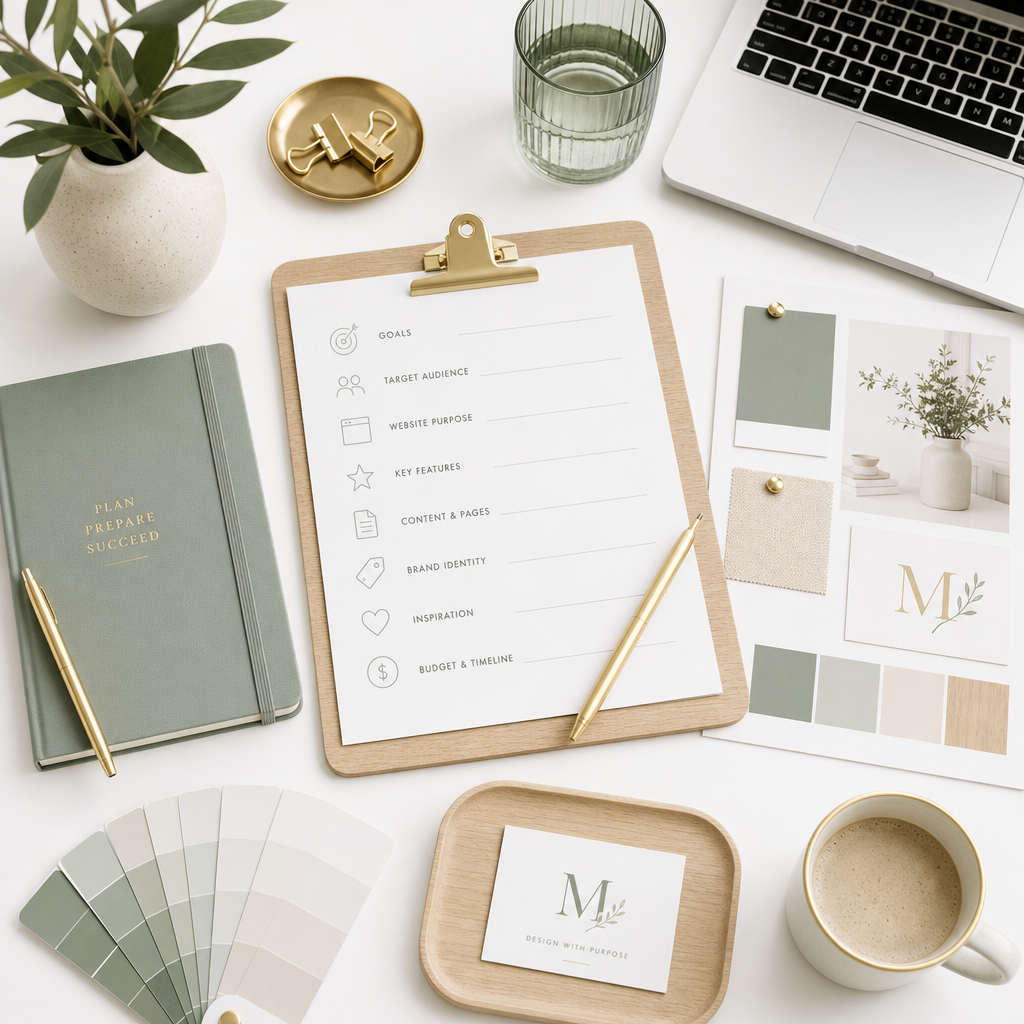
What to Prepare Before Hiring a Website Designer
Nicole
written by
You Might Also Like
In February 2015, a Tumblr user posted a washed-out photo of a dress with a simple question: is this white and gold, or blue and black? Within days, the image had divided the internet, made its way onto morning television, and become one of the most studied optical phenomena in modern vision science. I was […]

READ THE POST
Trust is not a conclusion. It’s a feeling. And online, it forms faster than most people realize. Research puts it at around fifty milliseconds for an initial visual impression, though the trust signals that follow in the first few seconds are what determine whether that impression holds. By the time a visitor has scrolled past […]

READ THE POST
Before you read a single word on a website, you feel something. That feeling — the one that happens in the first fraction of a second, before your conscious mind has processed anything — often comes from color. The brain responds to it almost instantaneously, faster than it processes language, faster than it evaluates layout […]

READ THE POST


