
I have been in design since 1995.
My first job was making graphics for television news. I drew maps in Photoshop, not CS3, not Photoshop 6. Just Photoshop. Version 3. I drew lines over scanned road atlases, pixel by pixel, because that was how you made a map appear on a news broadcast in the mid-nineties. It was painstaking work. It was also, looking back, an education in something I didn’t have a name for yet: the relationship between a tool’s limitations and the creativity those limitations force out of you.
I’ve been watching that relationship evolve for thirty years. And I’ve learned to pay attention to what changes when the tools do, not just what becomes easier, but what quietly becomes less necessary, and what we lose in the space between.
Every generation has its eulogy
At almost every inflection point in my career, I knew at least one designer who was convinced the new thing was the death of the art form.
Photoshop was going to end traditional illustration. Web-based builders were going to make designers obsolete. Drag-and-drop tools were going to commoditize everything. Stock photography was going to kill original visual thinking. And now AI. AI is going to end creativity itself, replace human designers entirely, produce a world of machine-generated sameness from which genuine artistry cannot survive.
None of the previous ones were right. I don’t think this one is either.
But I also don’t think the concern behind it is entirely wrong, and that distinction matters more than it might seem.
Where I come from on this
My father was a physicist who moved into computer programming in the 1970s. I grew up watching his enthusiasm for each new technology arrive like a gift. The genuine, uncomplicated delight of someone who saw tools as invitations rather than threats.
He wrote his first game when I was five years old. A poker game. I was in kindergarten, playing poker at home on a computer, decades before most households had one. That probably shaped something in me that I couldn’t have articulated at the time, a baseline assumption that new technology was interesting, worth understanding, worth exploring, and not to be feared.
So when I tell you I use AI tools in my business, I want you to understand it comes from that place. Not from resignation, not from competitive necessity, but from the same curiosity my father brought to every new thing he encountered. I use AI to generate the photography for these blog posts. I have a set of saved prompts, and when I finish writing a piece, I turn to those prompts to create images that give each post a consistent visual language; something that couldn’t have existed in the same way at any other point in my career.
Think about that progression for a moment. In the nineties, a blog like this would have had category images. A single photo per topic, probably shot on film, limited and generic. In the early two-thousands, stock photography became the standard, and we gained access to enormous libraries of images but lost any sense of visual cohesion. In the tens, designers started heavily editing and color-grading stock photography to create consistency across a brand – better, but still borrowed from someone else’s vision. Today, I can generate images that are specific to exactly what I’m trying to say, in exactly the visual register I want, with a consistency that would have required a dedicated photo shoot and a significant budget thirty years ago.
That’s not the death of anything. That’s a genuinely new capability. And I think refusing to see it clearly, in either direction, either as pure threat or pure gift, is a failure of the same curiosity that makes good design possible in the first place.
So what is actually being lost?
Here’s where I want to be careful, and honest, and specific. I think the conversation around fast design tends toward generalization in ways that make it less useful than it should be.
Fast design: design produced quickly, at scale, through tools that abstract the decision-making process, is not new. It’s been arriving in waves my entire career. What’s new is the speed and sophistication of the current wave, and the degree to which it can produce something that looks, on the surface, genuinely complete.
That’s the part worth paying attention to.
Earlier generations of fast design were visibly imperfect. A website built with a first-generation drag-and-drop builder looked like one. You could see the template underneath. That visibility created a kind of honest signal: this was made quickly, without deep investment, and it read accordingly.
The current generation of AI-assisted design doesn’t always carry that signal. It can produce work that looks considered, refined, intentionally composed. And that’s where the loss I’m most concerned about lives, not in what it looks like, but in what it skips.
The decisions that take time
In thirty years of design work, across television graphics and advertising and motion and web, I’ve learned one thing about quality that holds across every medium and every tool: the decisions that make something genuinely good are almost never the first ones.
They happen in the space between the draft and the final version. When you’ve sat with something long enough to realize the headline isn’t quite right, or the color is creating the wrong emotional register, or the layout is technically correct but doesn’t feel true to the business it’s supposed to represent. Those realizations don’t arrive on a schedule. They arrive when you’ve given the problem enough sustained attention to actually understand it.
Fast design compresses that space. It moves from prompt to output as quickly as possible, which means those slow, uncomfortable, specific decisions often don’t get made. What fills the space instead is pattern, the aggregate of what’s worked before, optimized for breadth, accurate enough to pass a quick look and specific enough for almost nobody in particular.
I drew maps over road atlases in 1995 because that was the only way to make a map. The limitation forced a kind of attention that produced something specific. I’m not nostalgic for the limitation, I’m grateful for what the attention taught me. And I think that’s the thing worth protecting as the tools get faster: not slowness for its own sake, but the quality of attention that slowness used to make unavoidable.
What sameness costs
Spend enough time looking at websites built primarily with AI assistance or mass-market templates and you start to feel it; that thing I’ve been watching accumulate across the industry for the past several years.
Everything is competent. Almost nothing is surprising.
The palettes are tasteful. The typography is considered. The layouts are clean. And the overall effect, at scale, is of an internet that has started to feel like a very large, very well-lit waiting room. It is pleasant and immediately forgettable.
This is what fast design produces in aggregate: a kind of visual consensus. The mean of all the patterns that have worked before, smoothed until the rough edges, and the distinctiveness, are gone. Individuality is not a byproduct of optimization. It’s usually the first thing optimization removes.
And here’s what that costs in practical terms: trust. Online, trust is built through specificity; through the details that couldn’t be fabricated, the photograph that’s clearly of a real place, the copy that sounds like it was written by someone who actually knows this business, the design decisions that feel like they came from genuine understanding of a particular brand rather than from a system trained on thousands of brands at once. When everything looks like it came from the same place, the things that didn’t start to stand out differently. Specificity becomes a signal. Distinctiveness becomes trust.
What I believe
I don’t think AI will end design. I’ve watched too many eulogies for that.
What I think it will do, what it’s already doing, is separate more clearly than ever the designers who understand what they’re making and why from the ones who are producing outputs without asking those questions. The tool is neutral. The judgment behind it is not.
I use AI every day. I’ll use it more as it develops. I’m curious about where it goes, the way my father was curious about every new thing he encountered, with genuine interest in what it opens up rather than anxiety about what it closes down.
But I also know what thirty years teaches you: that the work that lasts is almost never the work that happened fastest. That the small, slow, specific decisions — the ones that don’t show up in a screenshot or a portfolio or a prompt — are the ones that determine whether something is genuinely good or just convincingly complete.
Fast design is real and it’s useful and it’s here to stay. What we owe the businesses we work with, and the craft we’ve given our careers to, is the clarity to know which parts of the process it can serve, and the discipline to protect the parts it can’t.
Some things are worth the time they take.
After thirty years, I’m more convinced of that than ever.
The Rise of Fast Design and What We Lose Because of It
Nicole
written by
You Might Also Like
In February 2015, a Tumblr user posted a washed-out photo of a dress with a simple question: is this white and gold, or blue and black? Within days, the image had divided the internet, made its way onto morning television, and become one of the most studied optical phenomena in modern vision science. I was […]

READ THE POST
Trust is not a conclusion. It’s a feeling. And online, it forms faster than most people realize. Research puts it at around fifty milliseconds for an initial visual impression, though the trust signals that follow in the first few seconds are what determine whether that impression holds. By the time a visitor has scrolled past […]
READ THE POST
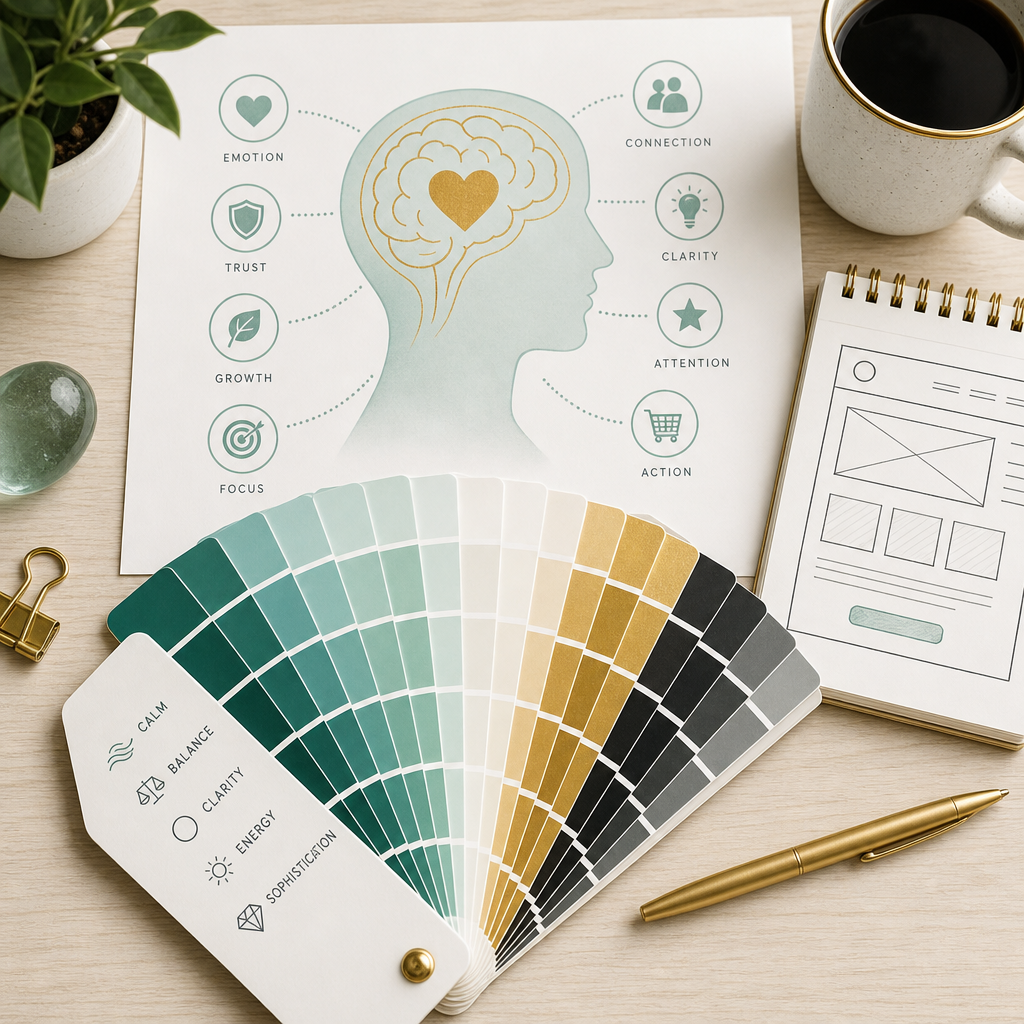
Before you read a single word on a website, you feel something. That feeling — the one that happens in the first fraction of a second, before your conscious mind has processed anything — often comes from color. The brain responds to it almost instantaneously, faster than it processes language, faster than it evaluates layout […]
READ THE POST


